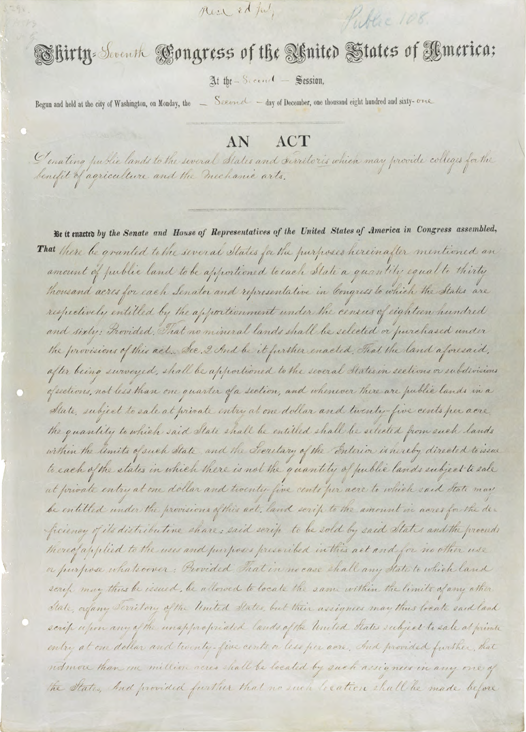
The First Morrill Act, or the Land-Grant Act of 1862, donated federal lands to the states for the purpose of establishing colleges of agriculture and mechanical arts. The goal of this legislation was to provide agriculturalists with formal education and standardized farming practices, with the idea that this would disseminate science and technology and improve the economy.
In effect, the Morrill Act set in motion the modern agricultural system we have today. Florida’s land grant college is the University of Florida.
Subsequent legislation produced the experimental stations, where new science and technology were created and disseminated. The Agricultural Experiment Stations Act of 1887, known as the Hatch Act, provided funding for experiment stations to conduct research on agricultural subjects including plant and animal biology, diseases, fertilizers, and soil and water chemistry, and in 1888, the Florida Agricultural Experiment Station was created to work in conjunction with the University of Florida.
A third piece of legislation important to Florida farmers was introduced in 1914 in the Smith-Lever Extension Act, which created the cooperative extension service, which brought new methods and concepts of food production and preservation to the farmers and homemakers who did not have the opportunity to attend college.