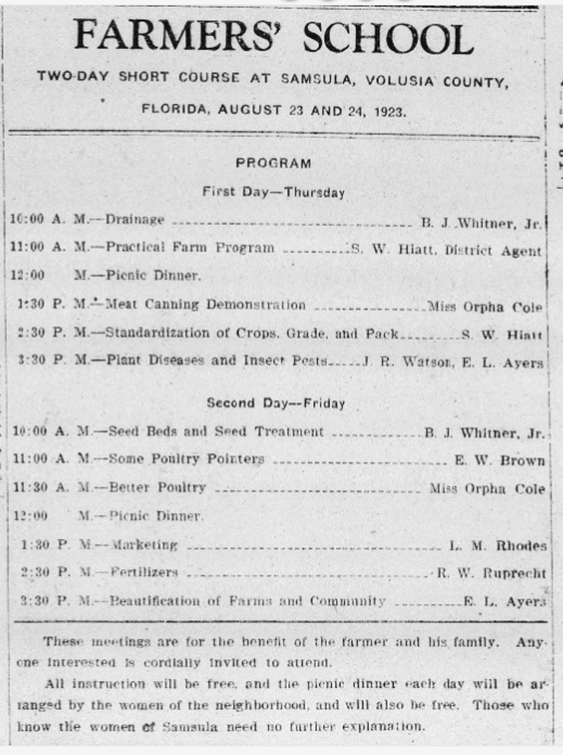
The following newspaper clippings announce educational courses offered in 1923 and 1924 (select the image to enlarge). Be sure to catch the last line in this first notice!
DeLand Daily News, pg. 2, Monday, Aug. 20, 1923. Retrieved from University of Florida Digital Collections, Jan. 28, 2026. Permanent link: https://ufdc.ufl.edu/aa00020301/00958
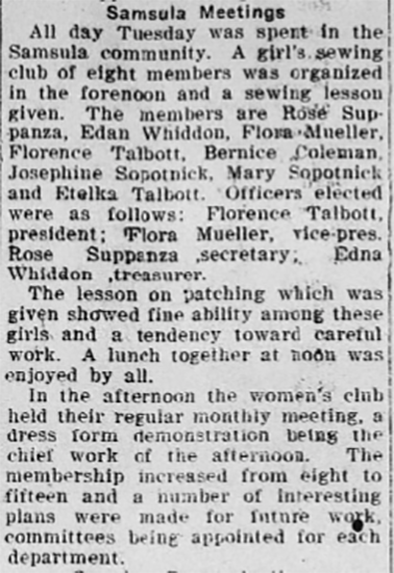
While the Extension Service provided training in agricultural practices for farmers, they also provided training in domestic arts such as canning and sewing. The Girls and Boys Clubs were precursors to the 4-H, and the Girls Clubs were closely affiliated with the women’s work.
“Home Demonstration Notes.” DeLand Daily News, pg. 2, Sept. 12, 1923. Retrieved from University of Florida Digital Collections, Jan. 28, 2026. Permanent link: https://ufdc.ufl.edu/aa00020301/00977
DeLand Daily News, pg. 5, Oct. 23, 1923. Retrieved from University of Florida Digital Collections, Jan. 28, 2026. Permanent link: https://ufdc.ufl.edu/aa00020301/01012
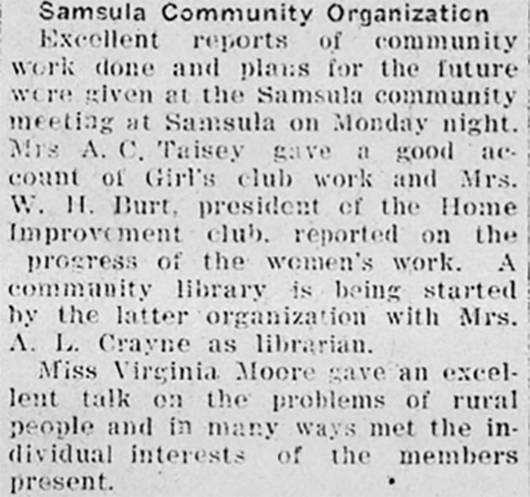
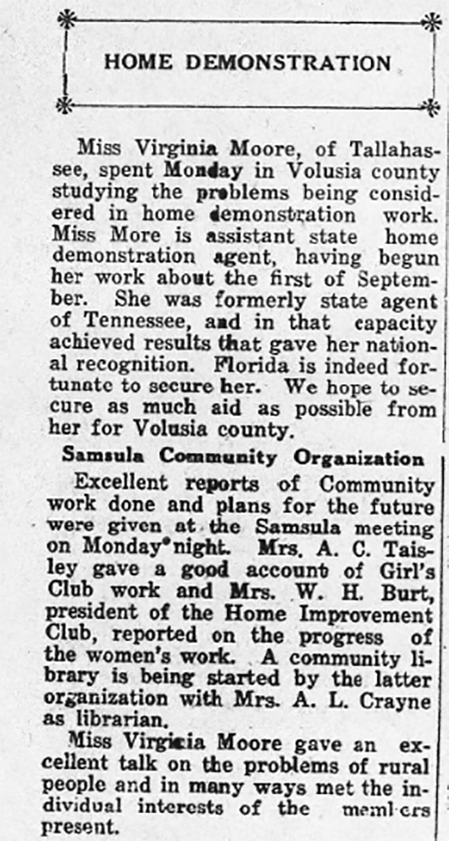
“Home Demonstration,” The DeLand Sun, pg. 8, Oct. 26, 1923. Retrieved from University of Florida Digital Collections, Jan. 29, 2026. Permanent link: https://ufdc.ufl.edu/aa00085633/00019
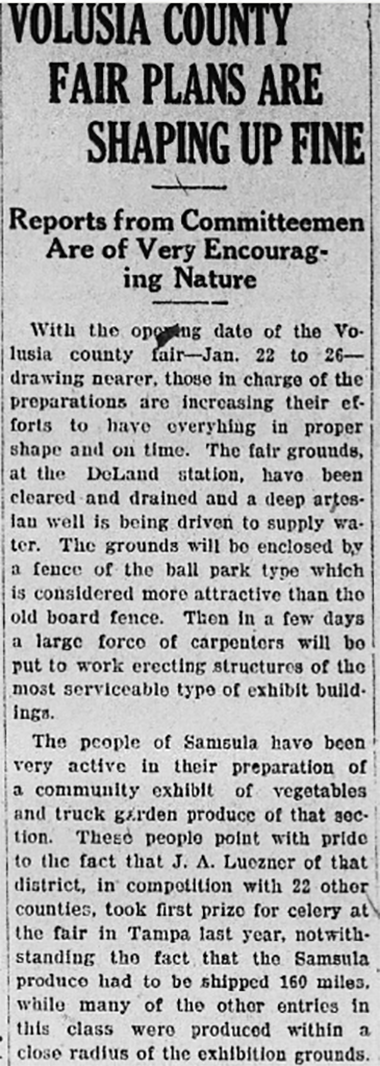
The Extension Service was also very involved in the creation of the county fair. This newspaper piece notes that Samsula farmers were “very active” in preparing for the fair.
DeLand Daily News, pg. 1, Nov. 9, 1923. Retrieved from University of Florida Digital Collections, Jan. 29, 2026. Permanent link: https://ufdc.ufl.edu/aa00020301/01027
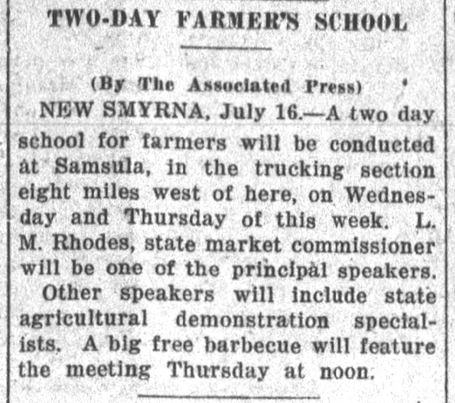
“Two-Day Farmer’s School,” The Fort Myers Press, pg. 3, July 16, 1924. Retrieved from University of Florida Digital Collections, Jan. 29, 2026. Permanent link: https://ufdc.ufl.edu/uf00079929/01490
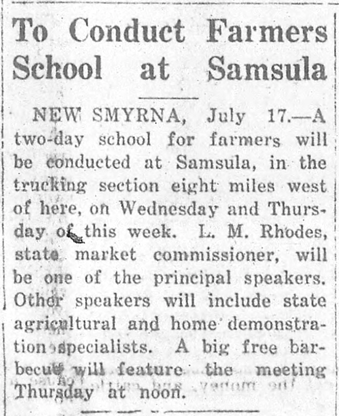
“To Conduct Farmers School at Samsula.”The Sanford Herald, pg. 5, July 17, 1924. Retrieved from University of Florida Digital Collections, Jan. 29, 2026. Permanent link: https://ufdc.ufl.edu/aa00083057/00248
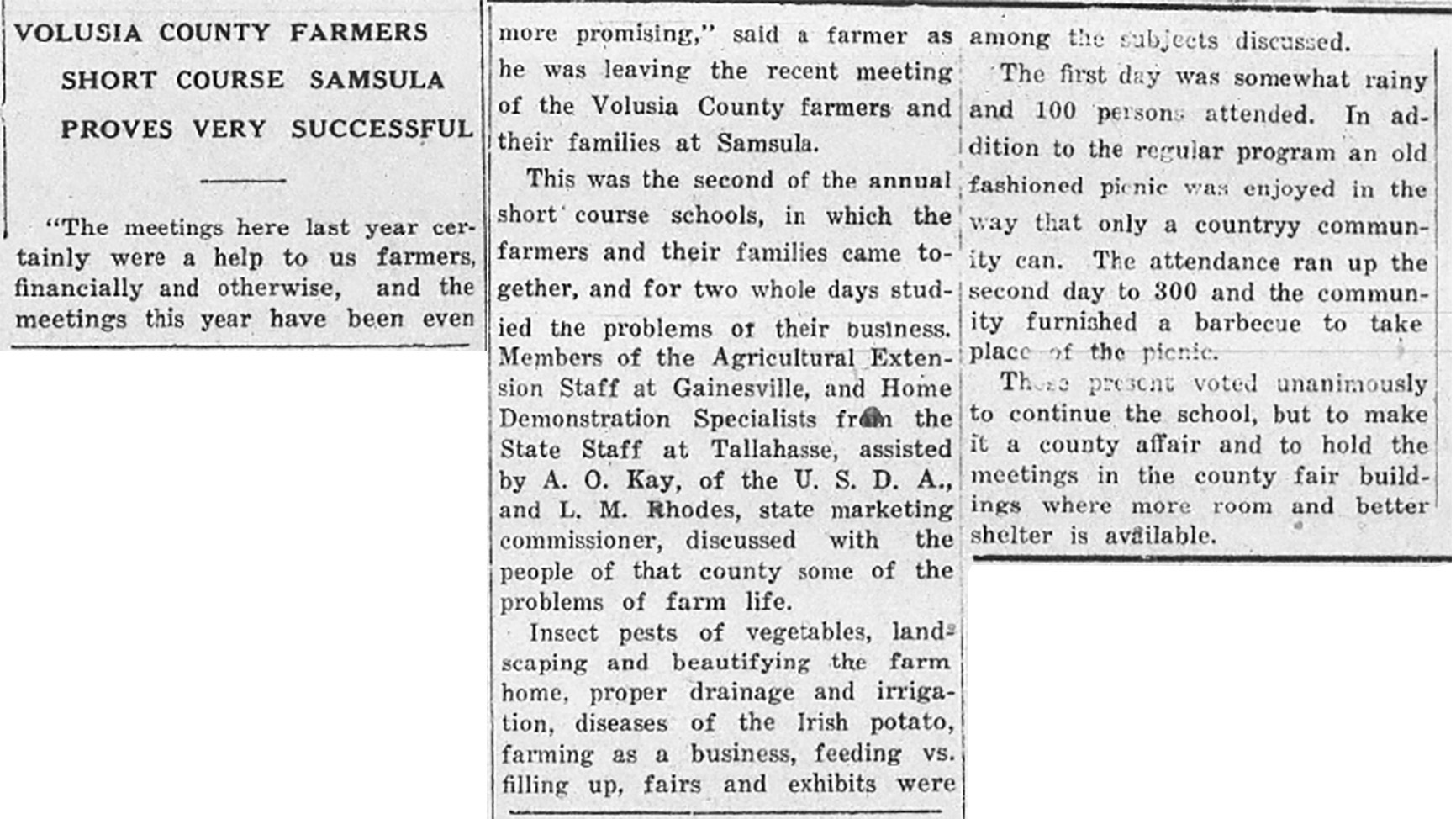
“Volusia County Farmers Short Course Samsula Proves Very Successful,” The Cocoa Tribune, pg. 9, July 31, 1924. Retrieved from University of Florida Digital Collections, Jan. 29, 2026. Permanent link: https://ufdc.ufl.edu/aa00088903/00384
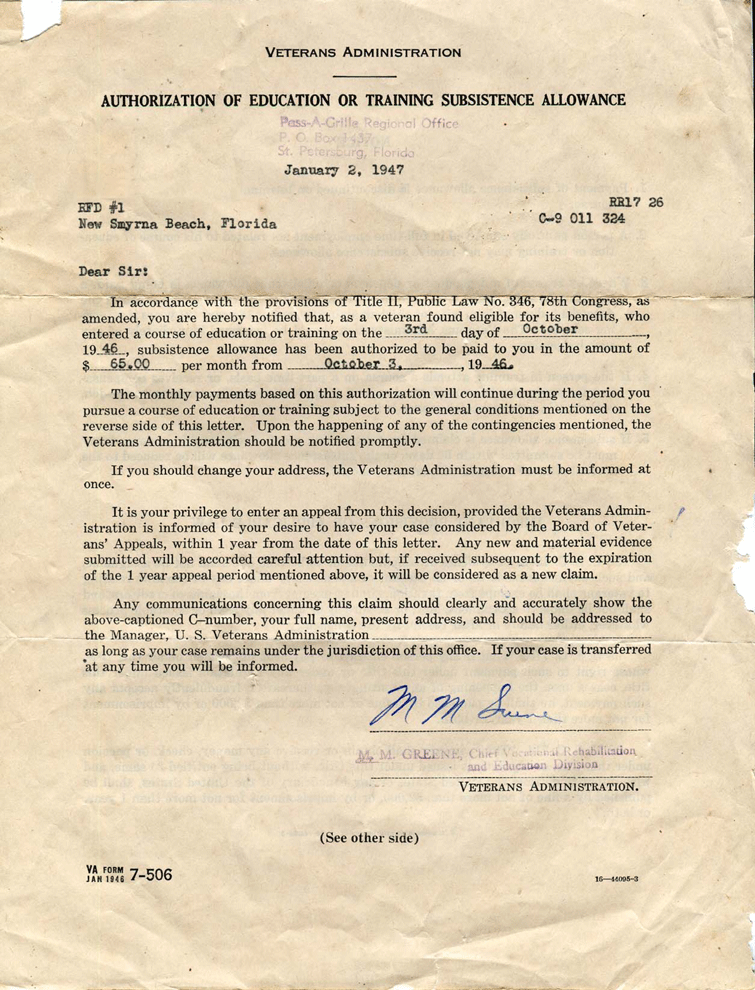
| After WWII, returning vets were offered an opportunity to attend vocational agriculture school, among other benefits. The first document shows an approved stipend, which was sometimes a convincing incentive for men who had grown up farming and probably knew quite a bit about agriculture already. The second image is a page from an annual Extension Service report. | |
| When asked what kind of things they covered in the VA training program, Bob Jontes (interviewed May 12, 2012) recalls his experience:They messed us up, we were on that ground that had been farmed, and we got this free dolomite, lime—you know, it was put out by the county . . . they spread it on pastures, still do, I guess. Well, our instructor, he didn’t really—he’s from Georgia, you know, and he lived in Sanford, and . . . it’s a different world of soil. They think you’re supposed to put lime on the soil every year. Well, it gets sweetened with all the water, limestone water, pH is way up there, I mean, in the blue . . . So that ruined our pepper business, but anyway that’s another story.
It lasted forever, but . . . they helped you keep books out of—you didn’t make enough money, but then you had to keep them books up to what you bought and spent. And, what you\’re gonna make in advance, and then see what you really did make, and all that. It’s a lot of government-type work, you know, . . . it doesn’t turn out too good with this weather. We don’t know what the weather is, wipe you out or [what], but anyway, it was bookwork. They had a welding shop set up we could use, which was in Ernie Hafner’s barn . . . he gave us a corner in there, and they put an electric welder in there and a lot of tools, and stuff to work on your tractor, and advice on what’s different. New methods of farming and whatnot, which we found out was trial and error, trial and error the rest of your life (laughs) But it was a what we lived on, the 90 bucks a month you got paid, so. . . That was good money in the bank. It was already spent, but it was more than you made in the field most of the time. |
 |
| The Extension Service was involved in organizing the training sessions, and F. E. Baetzman’s Volusia County Annual Report dated December 1st, 1945 to October 1st, 1946 gives an idea of what they expected to provide for the vets:This program is primarily for returning veterans, located on farms to take advantage of benefits available through existing legislation. It is designed to help those veterans in getting re-established on the farm by providing the necessary related instructions to fully prepare them to assume the duties of farm management and operation. In some instances, this program will also be of great benefit to those veterans employed in allied agricultural enterprises and will make up any deficiencies that might occur in outright training on the job. This plan will enable many veterans to acquire the knowledge necessary for useful farming who otherwise would be unable to obtain and agricultural education. H. L. Fagan is the Vocational Agricultural teacher at the DeLand High School, and has two assistant teachers to conduct these classes. Thirty veterans have signed up for the course. The agent is chairman of the county advisory committee for Veterans Training in Agriculture. (23) | 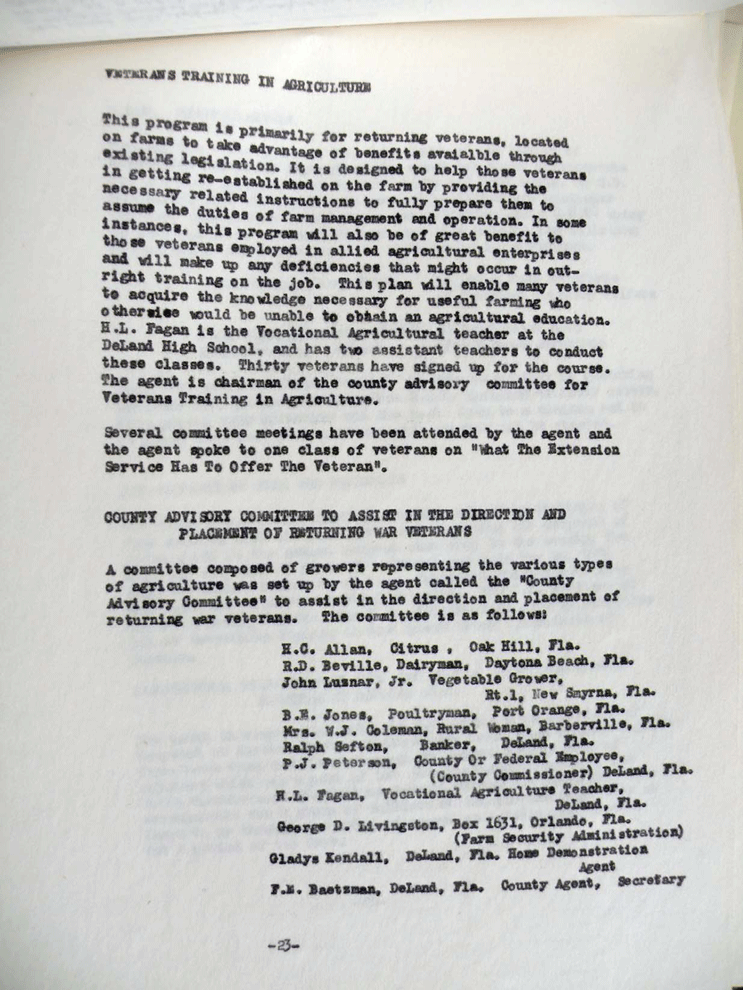 |
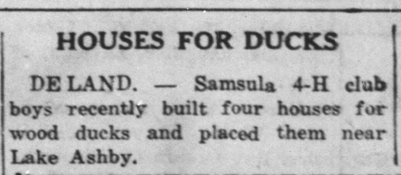
“Houses for Ducks,” Citrus County Chronicle, pg. 6, April 23, 1953. Retrieved from University of Florida Digital Collections, Jan. 29, 2026. Permanent link: https://ufdc.ufl.edu/uf00028315/07689
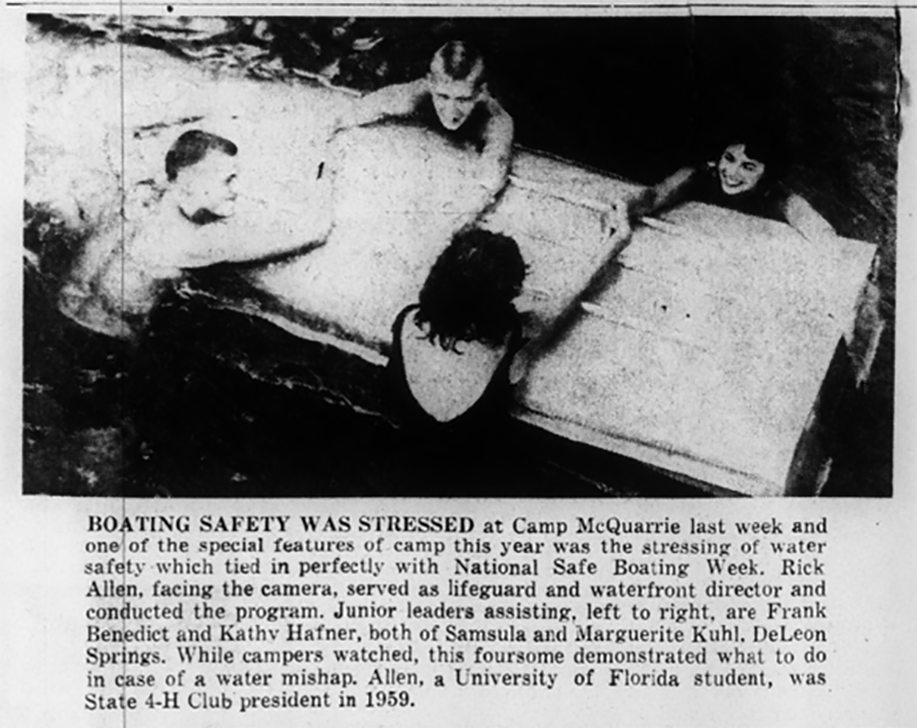
This newspaper notices highlight some Samsula kids joining others regional 4-H members at Camp McQuarrie in July of 1960 (select photo to enlarge).
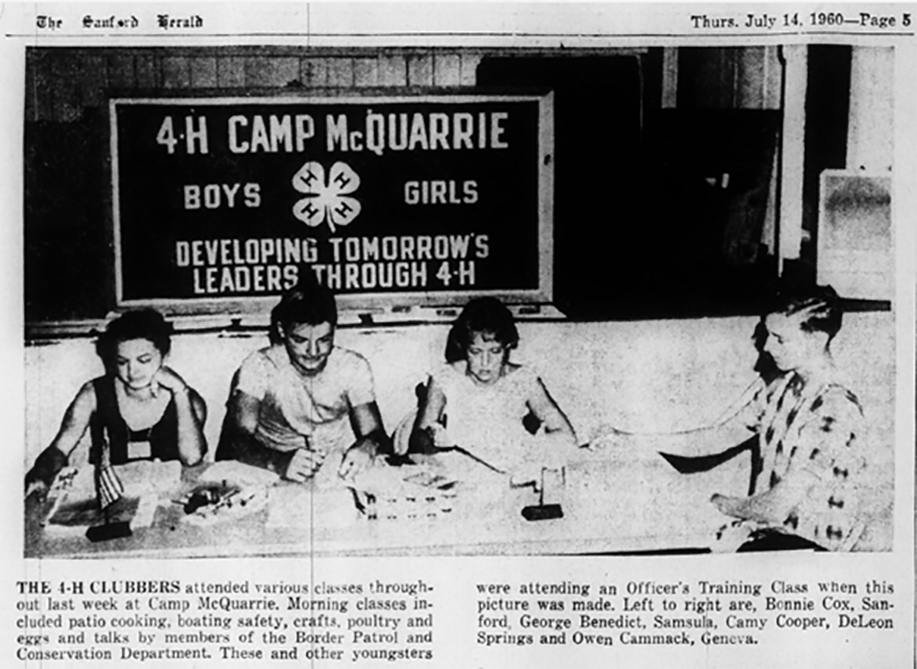
The Sanford Herald, pg. 5, July 14, 1960. Retrieved from University of Florida Digital Collections, Jan. 29, 2026. Permanent link: https://ufdc.ufl.edu/aa00087662/00944